Open Hours
7:00am-6:00pm Mon - Fri
Contact us
(903) 757-7282
Wedding dress preservation isn't really a yes or no decision. You're already going to do it eventually. The real decision is which version of it you get, the full set of benefits or a smaller, partial version of the same thing, and timing is the only variable that separates them.
Nothing about the service changes. What changes is how much of it is still actually available by the time you book.
Here are the three categories of benefits still fully within reach, and what starts to shrink the longer the dress waits.
The first weeks after your wedding are the window where your dress is easiest to fully restore. Here's what's actually at stake in that window, and why it closes gradually rather than all at once.
Some of the marks on your dress aren't visible yet. Champagne, sweat, body oil, and makeup soak into fabric fibers without leaving an obvious stain on your wedding day. Given time, those residues oxidize and turn into the yellow or brown discoloration brides often discover months later and assume is unrelated to anything that actually happened at the wedding.
This is the most immediate, tangible protection benefit on this list, since it applies to nearly every dress regardless of fabric type, and it's also the issue most brides don't realize is already in progress the moment the wedding ends.
There's a real difference between sealing a clean dress and sealing a dress that only looks clean. A specialist who preserves your dress starts with a genuinely clean garment in a stable, acid-free storage. A dress boxed without proper cleaning first traps those same invisible residues inside, where they keep reacting with the fabric long after the box is sealed.
You end up with damage that develops in the dark, unnoticed, for years, inside a box that was supposed to protect the dress rather than quietly seal a problem alongside it.
Acting soon means the box for which you eventually pay actually does the job it's designed to do, holding a stable dress steady, rather than sealing away an active problem where nobody will notice it developing.
Silk, lace, and other delicate fabrics develop weak spots wherever they're folded and left under pressure for extended periods. A dress hanging in a closet or folded into a box without acid-free tissue accumulates that stress month after month, whether or not any visible staining happens at the same time.
Early professional preservation addresses this directly, using proper padding and rotation techniques before those weak spots ever form. This benefit has nothing to do with stains or residue. It's a separate, purely mechanical reason to act soon, since fold stress accumulates on its own timeline regardless of how clean the dress otherwise.
Beyond the fabric itself, timing affects what you can actually do with this dress years from now, long after the specific details of the wedding day have started to blur.
If there's any chance a daughter, niece, or future family member might wear this dress one day, timely preservation keeps that door open. A dress preserved soon after the wedding retains its structure and color well enough to be worn again decades later.
Delayed preservation sometimes uncovers damage that's already set in, closing off that possibility before anyone actually gets the chance to decide if they want it. This matters even if you're not sure yet whether the dress will ever become an heirloom, since deciding later, once damage has already accumulated, means the option itself may no longer be fully available.
Plenty of brides aren't sure yet if they'll want to sell or donate their dress someday. That's a decision you don't have to make right now, but preserving the dress early keeps it in a condition where the option still genuinely exists.
A dress with set-in stains or fabric breakdown loses much of its resale and donation value, regardless of how it started or how beautiful the original design. Buyers and donation programs both expect a stable, structurally sound dress, not one carrying years of accumulated, untreated damage.
Damage from delay rarely stays minor. What starts as a treatable stain can become discoloration that requires specialized restoration work. Restoration almost always costs more than preservation would have in the first place, since it addresses damage that's already happened rather than simply maintaining a dress that never developed that damage at all.
Acting soon is typically the least expensive path over the life of the garment, not just the safest, even though preservation itself carries a real cost up front.
This is the category most preservation content skips entirely, and it matters just as much as the fabric science, since it has nothing to do with the dress itself and everything to do with you.
Right now, the dress is one more thing sitting in the back of your mind. Preserving it soon means it's actually done. No more wondering if you're waiting too long, no more low level worry every time you glance at the closet.
This benefit doesn't require any of the protection or longevity benefits to matter to you personally. Even a bride who isn't especially worried about oxidation or fold stress often still feels a real, specific relief once the dress is actually handled rather than pending.
The intake process is the right time to attach receipts, appraisals, wedding day photos, and notes about any known spills or incidents. Right after the wedding, you remember these details clearly. Weeks or months later, that same information gets harder to recall accurately, and some of it gets lost for good.
This documentation isn't just sentimental. It gives a preservation specialist useful context for treatment, and it creates a record that matters if the dress is ever insured, appraised again, or passed down with its actual history intact rather than reconstructed from memory decades later.
The wedding is over, but your follow through list probably isn't short: thank you notes, vendor payments, name changes, the honeymoon photos you still haven't sorted. Crossing preservation off that list is a genuine win in a season where wins can be hard to find.
This benefit is easy to dismiss as minor compared to protecting the fabric itself, but it's real, and it's worth naming directly rather than assuming only the fabric related benefits actually matter to a bride deciding whether to act this week or put it off further.
You don't need a complicated plan here. You need a handful of steps and a rough timeline.
How soon should you clean your wedding dress before this appointment? Not at all. Bring it exactly as it is and let the specialist see the actual condition first, rather than attempting anything yourself beforehand.
Preservation isn't a guarantee against every possible outcome. Some damage may already exist by the time a dress reaches a specialist, regardless of how soon it's brought in. A good specialist gives you an honest assessment at intake rather than promising a perfect result before they even see the dress. That honesty is part of what you're actually paying for.
McLendon Cleaners gives Longview brides an honest intake to the wedding dress preservation process – inspection first, damage assessment openly shared, and treatment individualized to what your specific dress actually needs.
We've cared for wedding dresses in Longview, Texas for over 75 years, offering personalized, in-house preservation for every dress that comes through our doors. We inspect the beading, embroidery, and delicate fabric specifically, treating each area according to what it actually requires rather than a single process applied to every dress.
Schedule an intake this week or call to describe your dress, and we'll walk you through exactly which of these benefits are still fully available for your specific dress.
Phone: +1 903 345 8841
Email: care@mclendoncleaners.com
You might have heard bridal experts recommend "acid-free preservation boxes" and perhaps wondered if it's just a fancy storage option or if it genuinely matters. Can a special box really make a difference in protecting your wedding dress from discoloration, fabric deterioration, and yellowing over time?
If you take the word of wedding dress preservation specialists who have seen firsthand what happens when dresses are stored improperly versus when they’re preserved the right way, the answer is and will always be a yes.
So let’s get into it—what exactly are acid-free preservation boxes, and do they really live up to the hype?
While both acid-free and regular preservation boxes claim to protect your dress, the materials from which they’re made—and how they interact with delicate fabrics—are very different. To help you understand what sets them apart, here’s a side-by-side look at their key features:
| Category | Acid-free Preservation Box | Regular Preservation Box |
|---|---|---|
| Material Composition | Made from pH-neutral, acid-free, lignin-free board | Often made from standard cardboard or paperboard |
| Chemical Stability | Chemically stable; prevents fabric degradation | May release acids over time, risking fabric damage |
| Archival Quality | Meets museum-grade storage standards | Typically not archival quality |
| Tissue Paper Used | Acid-free, buffered or unbuffered tissue | Often uses standard tissue or none at all |
| Long-term Suitability | Designed for decades of safe storage | May degrade or discolor fabrics over time |
| Common Usage | Professional wedding dress preservation and heirloom items | Basic garment storage or short-term boxing |
Using an acid-free preservation box isn’t just a trend—it’s a trusted method used by museum curators, textile conservators, and professional dress preservationists to protect delicate garments from irreversible damage. So if you plan to pass down your dress, reuse parts of it, or simply keep it as a cherished memory, you can't go wrong with it.
Acid-free materials keep harmful chemical reactions from breaking down your dress fabric over time. This is what helps your dress stay true to its original color—whether it’s bright white, ivory, blush, or champagne.
Delicate materials like silk, lace, and tulle can become brittle when exposed to acidic environments. An acid-free box helps maintain the strength and integrity of those fragile fibers, so your dress stays intact for decades.
Invisible residues—like body oils or sugars from your wedding cake—can oxidize and leave behind dark stains if your dress is stored in the wrong conditions. Acid-free boxes paired with acid-free tissue slow down that process dramatically.
These boxes are designed to keep out light, dust, and moisture, which are all major culprits of fabric breakdown. It creates a micro-environment that’s ideal for preservation without needing fancy climate controls.
Whether you want to pass down your dress, repurpose it into another garment, or simply take it out years from now to reminisce, an acid-free box ensures it will be in the best possible condition when you do.
There’s a reason acid-free boxes are used in museums to store vintage textiles and historical garments. The same preservation standards used for priceless artifacts are applied to your wedding dress—because it deserves nothing less.
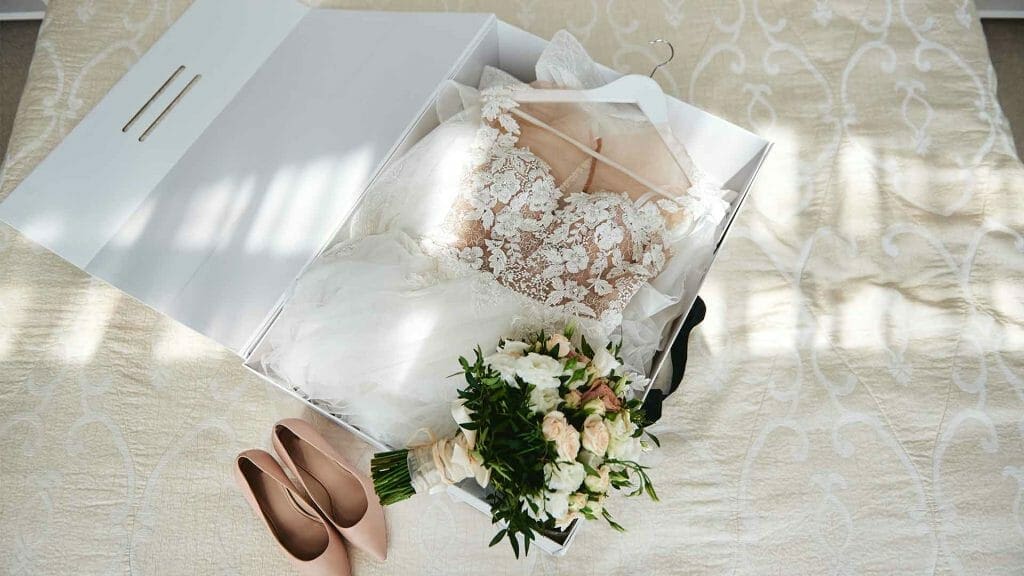
This is a great question, indeed! If you take the time to professionally clean and preserve your dress, it’s only natural to wonder how long that protection will actually last. When properly cleaned, handled, and stored in an acid-free preservation box, a wedding dress can safely be stored for 30 years or more without significant fabric deterioration. In fact, many bridal preservation experts consider acid-free boxes to be the gold standard for long-term storage, especially when paired with acid-free tissue and kept in a cool, dry environment away from sunlight.
It’s worth noting, though, that no storage method is completely hands-off forever. To ensure your dress stays in the best condition possible, it’s a good idea to check on it every few years. Look for any changes in the fabric, and make sure the box remains intact and undamaged by humidity or pests.
Before it ever goes into the box, your dress needs to be thoroughly cleaned to remove makeup, sweat, dirt, and hidden stains (like champagne or sugar, which can turn brown over time).
Even the best preservation box can’t do it all if it’s stored in a hot attic or damp basement. For best results, keep the box in a cool, dry place—under your bed, in a closet, or on a shelf indoors.
Whenever you do take a peek, make sure your hands are clean—or better yet, wear cotton gloves. Even natural oils from your skin can cause damage over time.
Resist the urge to open the box often. The more it’s exposed to air, the higher the chance of moisture or pollutants getting inside. Acid-free preservation boxes often include a viewing window so you can look without disturbing the seal.
Think of your acid-free box as an insurance policy for your dress. It protects your dress from everything the outside world can throw at it—light, moisture, air, time—so you can preserve those memories exactly how you want.
At McLendon Cleaners, we offer inhouse Wedding Dress Cleaning and Preservation Service, which means your dress never leaves our facility. No third-party shipping. No outsourcing. Just expert care from the same trusted hands start to finish.
We personally treat every dress using eco-friendly, fabric-safe cleaning methods to gently remove stains, oils, and residue. Once cleaned, your dress is packed in a museum-quality preservation box in premium acid-free materials designed to prevent yellowing, creasing, and fabric damage over time. And because everything stays local, you’ll always know where your dress is—and who's caring for it. In addition to preserving your wedding dress, we also offer accessory preservation for veils, headpieces, belts, gloves, jewelry, and even shoes.
Call us today at 903-551-6835 or email care@mclendoncleaners.com to book your appointment. We’re open Monday to Friday, 7:00 AM–6:00 PM, and Saturday 8:00 AM–12:00 PM.


✅ Up to 5 clothing pieces
⏰ Includes Next Day Service
Rewards expire at the end of the month!
Exclusions apply. Offer valid on everyday wear only.